
Bug zappers are a staple of summer nights, the familiar electric crackle, the blue glow on a patio, the promise of fewer mosquito bites. But choosing, installing, and maintaining one isn’t as simple as plugging in a light. Different models suit different spaces, placement affects performance more than wattage, and not all flying pests are equally drawn to UV light. This guide walks homeowners through selecting the right bug zapper, positioning it for maximum kills, keeping it running safely, and understanding when it’s not the best tool for the job.
Table of Contents
ToggleKey Takeaways
- Bug zappers use UV light and electrified grids to attract and kill flying insects, but mosquitoes make up less than 5% of the catch since they’re drawn more to CO₂ and body heat than UV light.
- Proper placement 6–8 feet high and 15–25 feet away from gathering areas matters more than wattage for maximizing bug zapper effectiveness and protecting outdoor living spaces.
- A well-maintained bug zapper requires only weekly tray emptying, monthly grid brushing, seasonal bulb replacement, and annual cord inspection while using GFCI-protected outlets for safety.
- Bug zappers are most effective for general flying pests like gnats and flies but should be combined with habitat modification, traps, and exclusion methods for comprehensive pest control.
- Budget $30–$60 for basic outdoor models and $80–$150 for weatherproof units, replacing UV bulbs every 3,000–4,000 hours at a cost of $8–$15 per bulb.
What Is a Bug Zapper and How Does It Work?
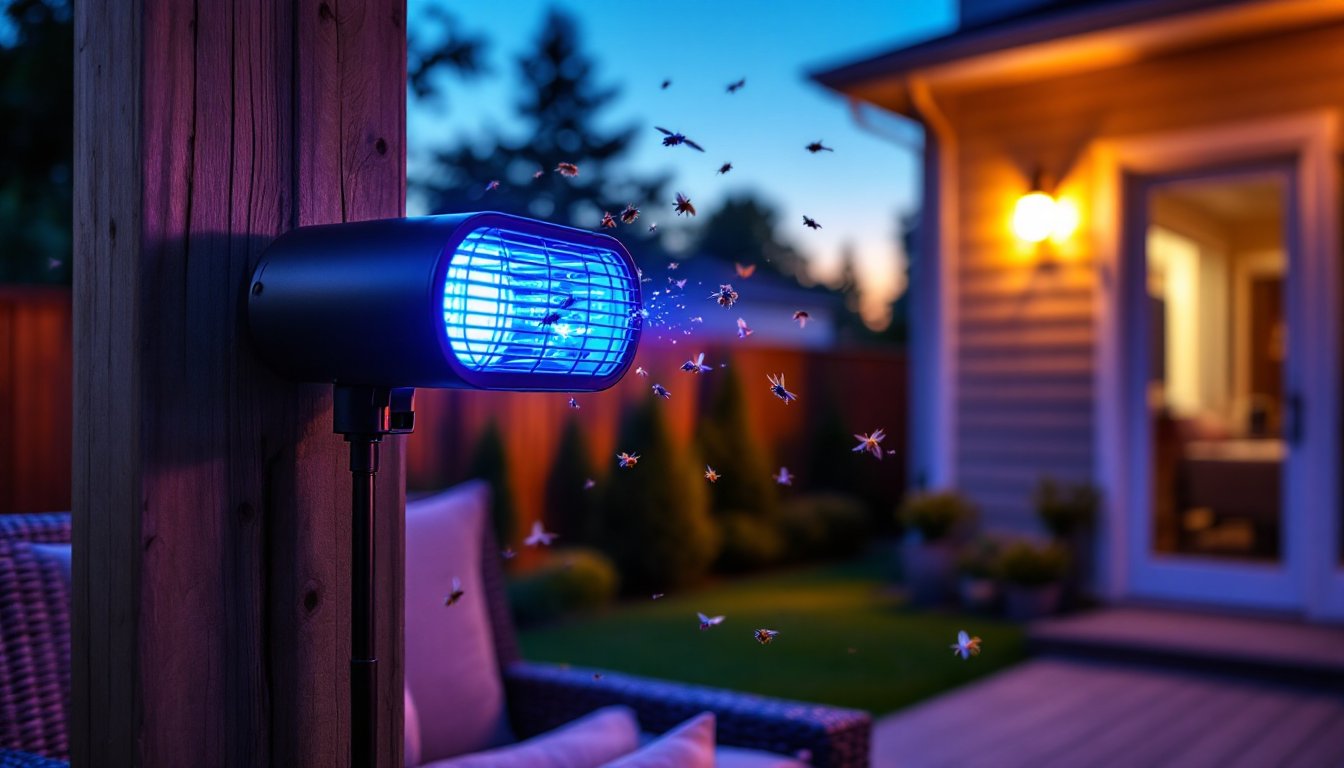
A bug zapper is an electric insect trap that uses ultraviolet (UV) light to attract flying pests and an electrified grid to kill them on contact. The device emits light in the 350–370 nanometer wavelength range, which many nocturnal insects, especially moths, beetles, and some mosquitoes, find irresistible.
Here’s the basic mechanism:
- UV lamp draws insects toward the device
- Insects fly through or land on a metal mesh grid charged with 2,000–4,000 volts
- Current passes through the insect, killing it almost instantly
- Dead bugs fall into a collection tray below the grid
Most residential models run on standard 120-volt household current and consume 10–40 watts, roughly the same as a compact fluorescent bulb. Commercial-grade units may draw more power and cover areas up to 1.5 acres, but typical backyard zappers handle 0.25–0.5 acres.
The effectiveness depends on the insect species. Mosquitoes are less attracted to UV alone compared to moths and beetles: they’re drawn more to carbon dioxide and body heat. Bug zappers kill plenty of flying insects, but studies show that mosquitoes often make up less than 5% of the total catch. That’s not a knock against the device, it’s just realistic expectation-setting.
Benefits of Using Bug Zappers for Pest Control
Bug zappers offer several practical advantages for homeowners dealing with flying pests:
• Chemical-free operation: No pesticides, sprays, or attractant baits that require refilling
• Low ongoing cost: After the initial purchase, only the UV bulb needs replacement every 3,000–4,000 hours (typically one season)
• 24/7 operation: Runs continuously during dusk and nighttime hours without supervision
• Broad coverage: A single unit can protect a deck, patio, or garage work area
• Minimal maintenance: Empty the tray weekly, wipe the grid monthly, that’s it
For outdoor gatherings, bug zappers reduce nuisance insects like gnats, midges, and flies that hover around food and drinks. They’re especially useful near livestock areas, trash enclosures, or compost bins where flies breed. Unlike citronella candles or coil incense, zappers don’t produce smoke or scent, and they work in light wind.
Some homeowners integrate zappers into broader integrated pest strategies that combine multiple control methods. A zapper handles airborne pests while traps, barriers, and habitat modification address crawling insects and larvae. According to product testing labs, well-placed zappers can reduce flying insect populations by 50–75% in controlled outdoor spaces.
Choosing the Right Bug Zapper for Your Home
Selecting a bug zapper comes down to coverage area, build quality, and whether it’s rated for indoor or outdoor use. Here’s what to evaluate:
• Coverage area: Match the manufacturer’s rating to your space, don’t expect a 0.25-acre unit to protect a full acre
• Grid voltage: 2,000V is standard for residential use: higher voltage doesn’t necessarily mean more kills
• Bulb type and wattage: 15W UV bulbs are typical for smaller areas: 40W for larger yards
• Weatherproof housing: Look for IP44 or higher rating if mounting outdoors year-round
• Collection tray design: Slide-out trays simplify cleanup: some models include a cleaning brush
Budget $30–$60 for a basic outdoor model, $80–$150 for a weatherproof unit with larger coverage, and $200+ for commercial-grade systems. Avoid ultra-cheap units with flimsy grids, they fail within a season and often lack proper electrical certification.
Indoor vs. Outdoor Bug Zappers
Outdoor models are built to withstand rain, UV degradation, and temperature swings. They often include hanging chains or mounting brackets for poles and eaves. Use these for patios, garages, barns, and open pavilions.
Indoor zappers are quieter, more compact, and designed for kitchens, workshops, and enclosed porches. They typically have lower wattage (10–15W) and may include decorative housings that blend with interior finishes. Don’t use outdoor units indoors, they’re louder, attract more insects into the living space, and may not meet UL 2021 safety standards for enclosed areas.
If you’re managing pests in a garden without using synthetic chemicals, combining a zapper with organic methods provides layered defense.
Best Placement Strategies for Maximum Effectiveness
Where you hang a bug zapper matters more than its wattage. Poor placement turns a $100 unit into a $100 lawn ornament.
Optimal placement guidelines:
- Mount 6–8 feet above ground level, high enough to avoid toddlers and pets, low enough to intercept low-flying insects
- Position 15–25 feet away from gathering areas, draw bugs away from decks, seating, and doorways, not toward them
- Avoid competing light sources, don’t place near porch lights, windows, or landscape lighting that dilutes the UV attraction
- Hang near insect travel paths, edges of yards, near shrubs, or between outdoor lights and seating areas
- Keep it clear of obstructions, no overhanging branches, gutters, or dense foliage that block insect access
For corner lots or wraparound decks, two smaller zappers often outperform one large unit. Place them on opposite sides to create overlapping zones. If you’re protecting a garage workshop, mount the zapper near the overhead door rather than deep inside, it intercepts bugs as they enter.
Don’t mount a bug zapper:
• Directly above food prep areas (falling insect debris)
• Near bedroom windows (the zap and hum disturb sleep)
• In wet locations without proper GFCI protection, even weatherproof units need ground fault protection per NEC Article 210.8
For larger properties or commercial applications, map out zones and place units at perimeter points rather than clustering them centrally.
Maintenance and Safety Tips for Bug Zappers
Bug zappers are low-maintenance, but neglect leads to reduced performance and potential safety hazards.
Routine maintenance schedule:
• Weekly: Empty the collection tray. Wear gloves, dead insects carry bacteria and can trigger allergies.
• Monthly: Unplug the unit, remove the tray, and brush debris from the grid with a dry nylon brush. Never use water while the unit is plugged in.
• Seasonally: Replace the UV bulb. Output degrades after 3,000–4,000 hours even if the bulb still glows. Mark the installation date on the bulb base with a permanent marker.
• Annually: Inspect the power cord for cracks, check mounting hardware for rust, and verify the GFCI outlet is functioning.
Safety warnings:
• Never touch the grid while plugged in, even if the unit appears off, residual charge can remain for several minutes
• Always use a GFCI-protected outlet for outdoor installations
• Keep zappers away from flammable materials, dry leaves, gasoline cans, paint thinner
• If a unit sparks excessively, smells like burning plastic, or trips the breaker, unplug it immediately and inspect for damaged components
PPE for maintenance: nitrile gloves, safety glasses (debris can flick up when brushing the grid).
Some homeowners attempt DIY repairs on broken grids or bulb sockets. Don’t. High-voltage components require proper insulation and clearances. If the grid is damaged, replace the unit or consult a licensed electrician. Replacement bulbs run $8–$15: replacement grids (if available) cost nearly as much as a new unit.
For detailed maintenance walkthroughs and product comparisons, resources like CNET’s appliance reviews break down long-term ownership costs.
Limitations and Alternatives to Bug Zappers
Bug zappers aren’t a silver bullet. Here’s what they don’t do well:
• Mosquito control: As mentioned, mosquitoes are more attracted to CO₂ and heat. Zappers kill mosquitoes, but they’re not the primary catch.
• Daytime pests: UV attraction works best at dusk and night. Flies and wasps active during the day ignore zappers.
• Selective targeting: Zappers kill beneficial insects, pollinators, predatory beetles, alongside pests. In gardens, this can disrupt natural pest control.
When to use alternatives:
• For mosquitoes: Use CO₂ traps, mosquito dunks in standing water, or propane-powered attractant systems. These target mosquitoes specifically.
• For flies: Sticky traps, fly bags, or bait traps near trash areas are more effective than zappers.
• For wasps/hornets: Bait traps with protein or sugar lures. Zappers don’t attract wasps reliably.
• For integrated control: Combine zappers with habitat modification (remove standing water, trim overgrown vegetation) and physical barriers (screens, netting).
In enclosed spaces like screened porches, a small plug-in zapper works well because insects are already contained. For open yards, zappers are one tool in a broader strategy.
Homeowners dealing with persistent infestations, especially carpenter ants, termites, or rodent issues, should consult pest control professionals. Sites like Angi’s contractor network connect users with licensed exterminators who can assess whether a pest problem is cosmetic or structural.
Finally, consider the broader pest control approach for your property. Zappers handle flying nuisances, but comprehensive control addresses breeding sites, entry points, and attractants. A clean gutter system, sealed trash bins, and well-maintained landscaping often reduce pest pressure more than any single device.
Bottom line: Bug zappers are effective, affordable tools for reducing flying insect populations in outdoor living spaces. They won’t eliminate every mosquito, and they’re not a replacement for good sanitation and exclusion practices. But for a backyard barbecue, a garage workshop, or a barn aisle, a properly placed zapper makes a noticeable difference. Mount it right, maintain it regularly, and set realistic expectations, and it’ll serve reliably for years.